
Travel insurance is often presented seamlessly within the booking journey — but behind that simplicity sits a structured and highly efficient integration between systems.
For travel partners, understanding how travel insurance is delivered within booking platforms helps explain how pricing is generated quickly, how options are presented consistently, and how the overall customer experience remains smooth.

Why Integration Matters in Travel Booking
Modern travel booking journeys — whether online or in-store — are built around speed, accuracy, and ease of use.
Customers expect:
- Fast and responsive booking experiences
- Clear options presented at the right time
- Minimal disruption during checkout
To support this, travel insurance needs to be integrated directly into booking systems, rather than treated as a separate process.
What Is an API (In Simple Terms)?
An API (Application Programming Interface) allows different systems to communicate with each other.
In the context of travel insurance, it enables a booking platform to:
- Send key trip information (such as destination, dates, and passenger details) in real time
- Receive relevant insurance options and pricing instantly
This allows insurance to be presented quickly and accurately, without the need for manual input or separate processes.
How Travel Insurance APIs Work in Practice
While the technical process happens behind the scenes, the outcome is straightforward and happens in seconds.
Typically:
- A customer or agent enters trip details into a booking system
- The system sends this information via an API
- Relevant insurance options and pricing are returned instantly
- These options are presented within the booking journey
This allows insurance to be included naturally, without interrupting the overall experience.
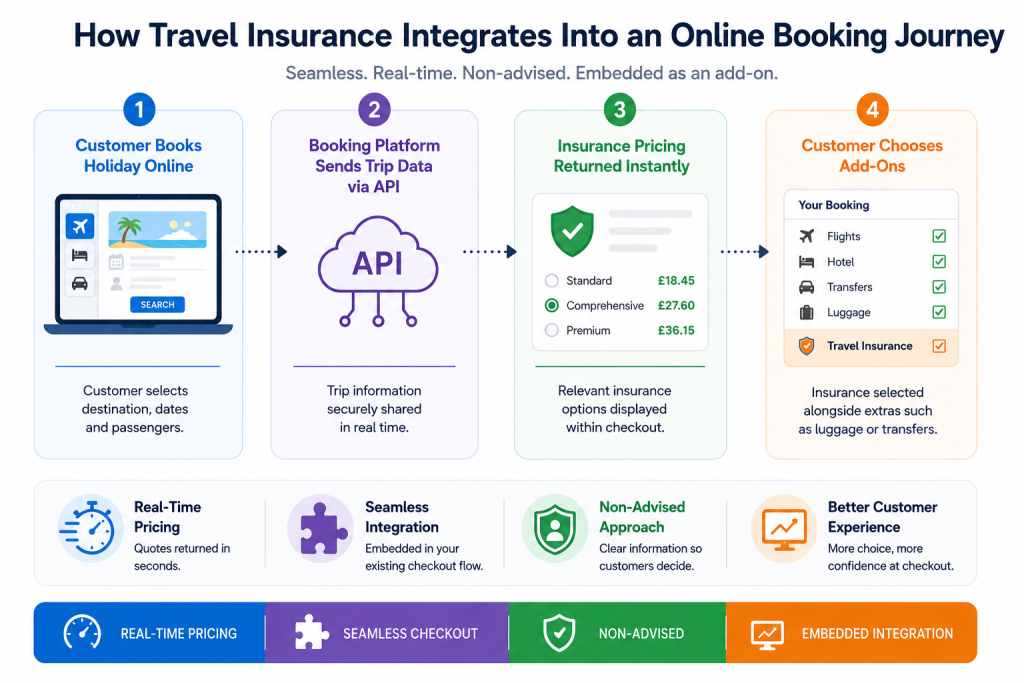
A Simple Example
For example, when a customer books a 7-day trip to Spain:
- The booking system captures destination, travel dates, and passenger details
- This information is sent via an API
- Insurance options and pricing are returned in real time
- The customer or agent is able to review and select cover as part of the booking
From the customer’s perspective, this feels like a seamless part of the process — even though multiple systems are working together behind the scenes.
Supporting Online Travel Booking Platforms
For digital travel brands, integration is essential to maintaining a smooth customer journey.
APIs allow travel insurance to be:
- Presented at a relevant stage of the checkout process
- Clearly displayed alongside other booking options
- Selected without interrupting the flow
This supports a fast, intuitive experience where customers can review and choose whether to include insurance as part of their booking.
Supporting Retail and Agent Booking Systems
In retail and adviser-led environments, APIs support speed and consistency at the point of sale.
For travel agents, this means:
- Quick access to insurance options based on trip details
- Reduced need for manual calculations or separate systems
- A more efficient and structured booking conversation
While the interaction is more personal, the underlying process remains consistent and supported by the same integration.

Speed, Accuracy and Consistency
API-driven integration enables:
- Real-time pricing based on accurate trip information
- Consistent outputs across different booking channels
- Reduced risk of errors compared to manual processes
In high-volume booking environments, this level of speed and consistency is essential to maintaining both efficiency and customer experience.
Supporting a Non-Advised Approach
API integration also plays an important role in supporting a non-advised model.
By presenting:
- Clear options
- Consistent product information
- Structured outputs based on trip details
it ensures that customers are able to make their own informed decision, without directing them toward a specific outcome.
This supports the expectation that information is presented in a way that is clear, fair, and not misleading.
Flexibility Across Different Partner Models
Travel partners operate across a wide range of systems and booking environments.
Based on experience supporting a range of travel partners, API-based integration allows for:
- Adaptability across different platforms and booking systems
- Consistent delivery of insurance options
- Scalability as booking volumes grow
This flexibility ensures that insurance can be delivered effectively across both online and in-store models, without requiring major changes to existing workflows.
Supporting Compliance Through Structured Integration
Even within a highly automated process, maintaining clarity and transparency remains essential.
As a business regulated by the Financial Conduct Authority, it is essential that:
- Information is presented clearly and accurately
- Customers understand they are making their own decision
- No personal recommendation is implied
Structured API outputs help ensure that information is presented consistently, supporting both customer understanding and regulatory expectations.
Customers should always review policy documentation to ensure the cover meets their individual needs.
Why This Matters for Travel Partners
Effective integration of travel insurance supports both operational efficiency and customer experience.
When delivered well, it helps:
- Maintain a smooth and consistent booking journey
- Provide accurate and timely insurance options
- Support regulatory expectations
- Enhance customer confidence in their choices
Ultimately, API-driven integration enables travel insurance to be delivered quickly, consistently, and transparently — supporting partners in providing a reliable, scalable, and customer-focused booking experience.